
Parenting Plans in Washington: How Courts Set Residential Schedules and Decision-Making

A Washington parenting plan is the court order that says where your child lives on which days, who makes the major decisions, and how the two of you handle disagreements later. When parents can’t agree, the judge sets those terms under RCW 26.09.187, after checking whether any limits on a parent apply.
If your spouse just filed for custody, or you’re worried about losing your kids, you probably want to know what’s going to happen. We can’t tell you that for your family in an article. The statute does list what the judge has to look at, though, so you can read a good part of it for yourself.
Below is when the state requires a plan, how courts set the schedule, how major decisions get allocated, what the mandatory form asks, how a plan changes later, and what the conflict rule says about sharing a lawyer.
Torrone’s Takeaways
- A plan is required in divorce, legal separation and invalidity cases. In a parentage case, it isn’t required unless a party asks.
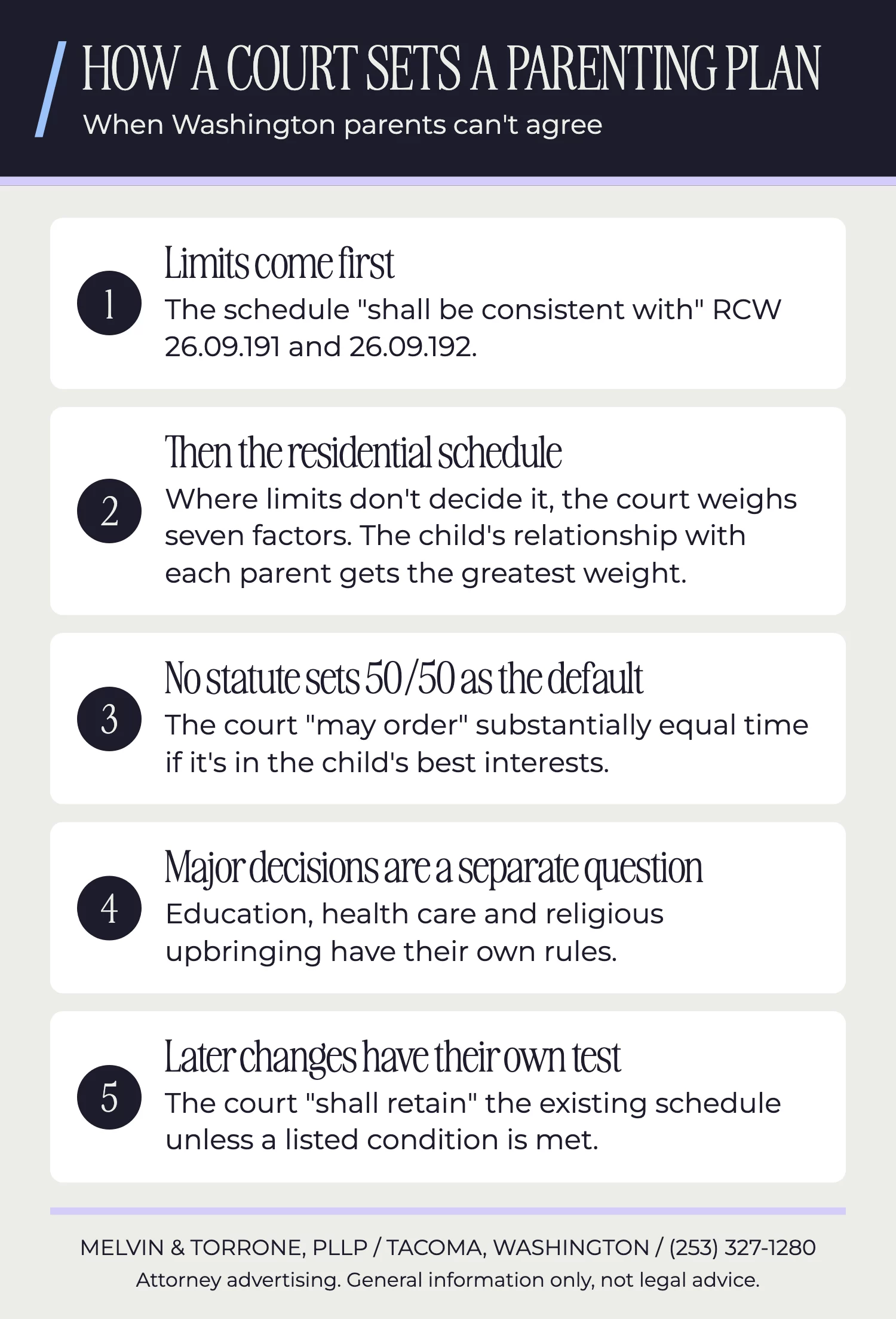
- Limits under RCW 26.09.191 and 26.09.192 come first. Where they don’t decide the schedule, the court weighs seven factors, and the child’s relationship with each parent gets the greatest weight.
- The statute says a court “may order” substantially equal time if it’s in the child’s best interests. No statute sets a 50/50 default.
- The schedule and major decisions are separate questions with separate rules.
- A small schedule change (no more than 24 full days a year, or no more than 90 overnights a year in specific situations) has its own standard. Most motions to change a plan have to show adequate cause first.
- A parent with most of the time or at least 45 percent who plans a move to a new school district generally gives 60 days’ notice first. Whether the move is presumed allowed depends on which of those two the parent has.
Table of Contents
- Torrone’s Takeaways
- What a Parenting Plan Is and When Washington Requires One
- How Courts Set the Residential Schedule
- How Courts Decide Who Makes Major Decisions
- What the Parenting Plan Form Asks, Section by Section
- Changing a Parenting Plan Later
- Do Both Parents Need Their Own Attorney? What the Conflict Rule Says
- Where to Start With Your Own Parenting Plan
- FAQ
What a Parenting Plan Is and When Washington Requires One
Whether Washington requires a plan depends on the kind of case you’re in:
- Divorce, legal separation or invalidity, for a marriage or domestic partnership. The decree must “make provision for a parenting plan” for any minor child, under RCW 26.09.050. Each party files a proposed plan under RCW 26.09.181, unless an agreed plan is filed.
- Parentage case. The court makes residential provisions on the same basis as a divorce case, “except that a parenting plan shall not be required unless requested by a party,” under RCW 26.26B.020.
That second line matters most if you’re unmarried. If an order establishing parentage was entered with no plan or schedule, a parent may ask for one by motion if fewer than 24 months have passed and the proposal keeps the same majority-time parent. Otherwise it takes a petition. There’s more on the steps for unmarried parents in a separate article.
Under RCW 26.09.184, a permanent plan has to contain three things: a way to resolve future disputes, an allocation of decision-making, and residential provisions for the child. RCW 26.09.187 gives the last two their own sets of rules.
| Question | What it settles | Main statute |
|---|---|---|
| Residential schedule | Which home your child is in on given days, including holidays, birthdays and vacations | RCW 26.09.187(3) |
| Decision-making | Who decides education, health care and religious upbringing | RCW 26.09.187(2) |
How Courts Set the Residential Schedule
A judge deals with limits on a parent before weighing anything else. Under the residential schedule statute, the schedule “shall be consistent with” RCW 26.09.191 and RCW 26.09.192, and the factors apply where those limits are “not dispositive,” meaning the limits don’t decide the schedule on their own. Limits are required for conduct such as a history of domestic violence or child abuse. They’re allowed for problems such as neglect or a long-term impairment.
There’s more detail in separate articles on how a criminal record fits under RCW 26.09.191, a closed CPS case and a no-contact order. ESHB 1620 (Laws of 2025, ch. 166) reorganized these sections effective July 27, 2025, which is why older pages cite different subsection letters.
Where the limits don’t decide it, the statute names seven factors. In plain words, and in the statute’s order:
- The strength, nature and stability of the child’s relationship with each parent. Under the statute, this factor “shall be given the greatest weight.”
- Agreements the parents made knowingly and voluntarily.
- Each parent’s past and potential performance of parenting functions, including who has taken greater responsibility for the child’s daily needs.
- The child’s emotional needs and developmental level.
- The child’s relationships with siblings and other significant adults, and ties to home, school and activities.
- The wishes of the parents, and of a child mature enough to express reasoned and independent preferences.
- Each parent’s work schedule.
In Katare v. Katare (2012), the Washington Supreme Court said a trial court “wields broad discretion” in fashioning a permanent plan, guided by the Parenting Act, including these factors.
Is 50/50 the Default in Washington?
No Washington statute sets 50/50 as the default. Under RCW 26.09.187(3)(b), where limits are not dispositive, the court “may order” that a child frequently alternate between households “for brief and substantially equal intervals of time if such provision is in the best interests of the child.” The court may consider how close the parents live, to the extent needed to share parenting functions.
In In re Marriage of Kovacs (1993), the Washington Supreme Court held that the Parenting Act “does not create a presumption in favor of placement with the primary caregiver.” That case addressed a primary-caregiver presumption, which is a different question from 50/50, and the statute’s wording has changed since.
How Courts Decide Who Makes Major Decisions
However major decisions get allocated, each parent decides day-to-day care during their own time, and either parent may make emergency decisions about the child’s health or safety. Major decisions means the three areas RCW 26.09.184 names: education, health care and religious upbringing. A court “shall approve” the parents’ agreement on these if it’s consistent with any limits and made knowingly and voluntarily. On the schedule, by contrast, an agreement is one of seven factors.
Without a qualifying agreement, RCW 26.09.187(2)(b) says the court shall order sole decision-making to one parent when it finds any of these:
- A limit on the other parent’s decision-making is required by RCW 26.09.191 or 26.09.192.
- Both parents oppose mutual decision-making.
- One parent opposes it, and that opposition is reasonable under the listed criteria.
Those criteria are any limit, each parent’s history of participating in decisions, their demonstrated ability and desire to cooperate, and how close they live to one another as it affects timely decisions. History and cooperation get examined “in each of the areas,” so the court looks at school, health care and religion one by one. None of the criteria asks which parent has more residential time.
A domestic violence finding brings a rebuttable presumption of sole decision-making, and after that finding the court shall not require face-to-face mediation, arbitration or other interventions that put the parties in the same physical or virtual space. Where a limiting factor applies, or a parent cannot afford the process, the court shall not order a dispute resolution process other than court.
What the Parenting Plan Form Asks, Section by Section
You’ll see the plan as a numbered court form, and each parent’s proposal uses the same one. Washington’s mandatory form is FL All Family 140, 28 pages with all its attachments. As of November 2026, the version in use is dated 07/2025, stamped in the footer. An older 07/2017 version with outdated statute references can still turn up online.
| Section | What it asks |
|---|---|
| 1 and 2, Type and children | Whether this is a parent’s proposal, a temporary order or a final order, and each child’s name and age |
| 3, Limitations | Yes-or-no questions on (a) abandonment, child abuse, domestic violence or assault, (b) other problems such as neglect, substance abuse or abusive use of conflict, and (c) a sex offense or sexual abuse of a child. If none applies, Attachments A, B and C come out |
| 4, Custodian | A label for other state and federal laws, naming the person the children are scheduled to live with most of the time. It says the label does not change anyone’s rights under the plan |
| 5, Schedule attachments | Attachment R for a residential schedule, or A or B for no contact or a limited schedule. It says the court should not sign without at least one |
| 6, Decision-making | A chart marking each major decision Joint or Limited to a named parent. School and non-emergency healthcare are printed, with blank “Other” lines for items such as extracurricular activities, international travel, cell phones, driver’s licenses, tattoos and haircuts |
| 7, Dispute resolution | Mediation, arbitration, counseling or court, how a parent gives notice, and how the parents split the cost |
| 8, Transportation | Where exchanges happen, and whether the picking-up or dropping-off parent arranges the ride |
| 9, Moving with the children | A printed summary of the relocation rules, covered below |
| 10 to 12, Other terms, proposal, order | Space for anything else, a signature under penalty of perjury on a proposal, then the judge’s signature and a contempt warning |
Religious upbringing is in the statute and has no printed row, and the form tells parents to list other important decisions under “Other.”
Attachment R has the week-to-week schedule. It has a school schedule in exact days and times, with separate lines for children under school age, a summer schedule, and a holiday schedule with odd and even years for each named holiday. You can add other significant days, such as Eid, Passover, Easter, Chinese New Year and birthdays. Attachment A covers limitations, B covers sex offenses or sexual abuse of a child, and C sets supervised visitation rules.
How a Plan Moves Through Pierce County
Statewide, in a chapter 26.09 case other than a modification, each party files a proposed plan by the earlier of 30 days after a notice for trial or 180 days after the case starts, though the parties can agree to extend the 180 days. A final order cannot be entered sooner than 90 days after filing and service, except a decree of legal separation, and that’s a minimum. Pierce County adds these steps:
- Seminar. Each parent completes an approved Impact on Children seminar within 60 days after service and attaches the certificate to the final plan (PCLSPR 94.05). Parents are never required to attend together. In a paternity case, the rule applies once parentage is established or acknowledged and a residential schedule is requested. It may be waived for good cause, and the county’s seminar page lists approved providers.
- Before trial. When the plan is still in dispute, Pierce County requires a settlement conference, and another dispute resolution process can stand in for it. On motion, the assigned judge may waive it for domestic violence, child abuse or other good cause (PCLR 16(c)).
- Agreed plans. The local rules list the papers presented for signature. Self-represented parents send proposed final orders to Family Court Services at least 7 days before the uncontested hearing.
- Help with forms. The Clerk’s court facilitators are a separate office from Family Court Services. The county’s self-help page explains how to book an appointment and what it currently costs.
Changing a Parenting Plan Later
Under RCW 26.09.260, the court “shall retain” the existing residential schedule unless a listed condition is met. Whoever’s asking files an affidavit of facts, and under RCW 26.09.270 the court shall deny the motion unless the affidavits show adequate cause for a hearing. A petition tied to a relocation objection doesn’t need that showing. In Pierce County, the petition is dismissed if the order on adequate cause isn’t obtained by the case schedule date.
| Kind of change | What the statute asks |
|---|---|
| Major change to the schedule | Facts that arose since the plan or were unknown to the court, a substantial change in the circumstances of the child or the nonmoving party, and a change necessary to serve the child’s best interests. Plus one of four: the parents agree; the child has been integrated into the petitioner’s family with the other parent’s consent in substantial deviation from the plan; the present environment is detrimental and the harm of a change is outweighed by its advantage; or the other parent was found in contempt at least twice in three years over residential time, or convicted of first or second degree custodial interference. RCW 26.09.260(1), (2) |
| Minor change, same majority-time home | A substantial change in either parent’s or the child’s circumstances. Plus one of three: no more than 24 full days in a calendar year; a move by the parent the child doesn’t live with most of the time, or an involuntary work-schedule change by a parent, makes the plan impractical to follow; or a total of no more than 90 overnights a year, where the plan doesn’t give reasonable time with that parent and more time is in the child’s best interests. RCW 26.09.260(5) |
| Decision-making and dispute resolution | A substantial change of circumstances of either parent or a child, and the adjustment is in the child’s best interest. RCW 26.09.260(10) |
A motion brought in bad faith means paying the other parent’s attorney fees and court costs. A parent under limits faces added rules when asking for up to 90 overnights, explained in the article on criminal convictions and custody.
When a Parent Wants to Move With the Child
- Who it covers. Under RCW 26.09.430, a person with whom the child lives most of the time, or who has substantially equal time, which RCW 26.09.525 says includes 45 percent or more under the court order.
- Notice. At least 60 days before a move to a different school district, by personal service or mail requiring a return receipt, under RCW 26.09.440. A move within the school district needs only actual notice. Section 9 of the form lists exceptions, including a 5-day notice when the parent couldn’t have known in time, and safety delays.
- Objection. The other parent has 30 days after receiving notice. Except for good cause, if no objection is filed, the move shall be permitted, under RCW 26.09.500.
- If an objection is filed. Under RCW 26.09.520, there is a rebuttable presumption that the move will be permitted. The objecting parent must show that the detrimental effect outweighs the benefit to the child and the relocating person.
- The exception. Where the mover has substantially equal time, the presumption does not apply, and the court decides on the child’s best interests using the same factors, under RCW 26.09.525.
Do Both Parents Need Their Own Attorney? What the Conflict Rule Says
If you and the other parent are on opposite sides of a dispute in court, one lawyer can’t represent you both. Washington’s conflict rule, RPC 1.7, says a lawyer can’t represent one client asserting a claim against another client in the same proceeding, and Comment [23] says that “prohibits representation of opposing parties in the same litigation, regardless of the clients’ consent.”
The rule doesn’t mention parents or custody. How it applies when you and the other parent agree is a question for a lawyer looking at your case, and this article doesn’t answer it. Agreements have to be made knowingly and voluntarily under the parenting statute, so what each parent understands about what they’re signing is part of the question. Pierce County’s local rules also provide for self-represented parents, so some parents go through this without a lawyer.
Where to Start With Your Own Parenting Plan
We see this a lot. A parent sits down with us sure they’re about to lose their kids, and what they want first, before any talk of strategy, is a straight answer. So we open the parenting plan and start there. Because Washington courts decide these questions on the children’s best interests, we go through the parent’s real week: work hours, school, who handles drop-off, who’s been doing the daily caring. Then we tell them where that leaves them, including the parts that don’t help them.
If you’d like to go through your own situation that way, you can schedule a free, confidential consultation with our custody lawyers. Bring your current plan or any court papers you have.
FAQ
1. Can a father get full custody in Washington?
The parenting plan form says Washington law “generally refers to parenting time and decision-making, rather than custody.” So “full custody” means two questions the court decides separately, which are the majority of the schedule and sole decision-making. Any parent may propose either. The statute’s seven residential factors speak of “each parent,” and none mentions whether a parent is a mother or a father.
2. Will the judge ask my child where they want to live?
RCW 26.09.210 lets the judge interview a child in chambers, but RCW 26.09.187 doesn’t require it. It lists “the wishes of a child who is sufficiently mature to express reasoned and independent preferences” as part of one factor, and that factor sets no age. It doesn’t make a child’s wish decisive.
3. Does a temporary parenting plan decide the final one?
No. In entering a permanent plan, “the court shall not draw any presumptions from the provisions of the temporary parenting plan.” For the temporary plan itself, RCW 26.09.197 tells the court to give particular consideration to the child’s relationship with each parent and to which arrangement causes the least disruption while the case is pending.
4. What happens if the other parent doesn’t follow the plan?
A parent can file a contempt motion, and the court may issue an order to show cause. Under RCW 26.09.160, if a parent in bad faith doesn’t follow the residential provisions, the court must find contempt and order make-up time, costs and fees, and a civil penalty. A second failure within three years doubles the make-up time. Tying the plan to child support, or refusing to follow it, counts as bad faith. The plan form’s own warning reads, “You still have to follow this Parenting Plan even if the other parent doesn’t.”
This article is attorney advertising and shares general information only, not legal advice. Reading it or contacting Melvin & Torrone, PLLP does not create an attorney-client relationship. Every situation is different, so talk with a licensed attorney about yours.

Chris Torrone
Founding Partner, Melvin & Torrone PLLP
Chris Torrone is a dedicated advocate for clients facing family crises and criminal charges. With 20 years of experience practicing in Pierce County courts, Chris has built a reputation for meticulous case preparation and creative problem-solving in high-stakes litigation.