
Can I See My Kids With a No-Contact Order? Domestic Violence Charges and Parenting Time in Pierce County

If your kids are listed on your no-contact order and the no-contact box is checked, you can’t see or contact them until the order ends or the court changes it. If they aren’t listed and the other parent is protected, you still can’t go through that parent to arrange a visit. A missing name doesn’t clear you.
You may be saying “I need to see my kids,” or “I didn’t do anything,” or “it was mutual.” The order applies either way until a judge changes it. These orders exist to keep the protected parent and the children safe. The law also gives you a way to ask a court for a change.
Below: what to do first, what each order covers, which one controls, how to ask the court, what the family court does meanwhile, and the Pierce County and Tacoma details.
Torrone’s Takeaways
- Whether your kids are listed on the order decides nearly everything, and minors appear by initials.
- Kids not listed doesn’t clear you to contact a protected parent, directly or through someone else.
- No statute, court rule or appellate opinion cited here says which order controls, and the order itself says only the court can change it. So a parenting plan isn’t safe to rely on as permission to break it.
- The other parent’s invitation isn’t a defense.
- You can ask the court that issued the order to change it, including for supervised or limited contact, and the court may say no.
- A family court doesn’t need a conviction to find a history of domestic violence.
Table of Contents
- Torrone’s Takeaways
- What to Do First If You Have a No-Contact Order and Kids
- What a No-Contact Order Covers and What a Parenting Plan Covers
- Which Order Controls When a No-Contact Order and a Parenting Plan Conflict
- How to Ask the Criminal Court to Change the Order
- What the Family Court Does While the Charge Is Pending
- Pierce County and Tacoma Court Details
- When to Talk to a Lawyer Who Handles Both Kinds of Case
- FAQ
What to Do First If You Have a No-Contact Order and Kids
You’re holding the order, and the first thing you want to do is text about Friday’s pickup. Hold that text and start here.
- Read every checked box on your order today. Look for your kids’ initials, because the statewide form lists a minor by initials instead of a name.
- Stop all contact with everyone on the order, including through other people. Even a message that’s only about the kids counts as contact.
- Don’t take a yes from the other parent as permission.
- Find the court’s name and your case number on the order, and keep it with any parenting plan.
- Talk to a lawyer before you ask any court for anything and before you sign a declaration in a family case.
Violating a domestic violence no-contact order is a gross misdemeanor, and some violations are class C felonies under RCW 7.105.450. Washington’s general maximum for a gross misdemeanor is 364 days in jail, a $5,000 fine, or both, under RCW 9.92.020. A 2015 chapter of the state’s Domestic Violence Manual for Judges, which is guidance and not law, notes that most courts also make following the order a release condition, so a violation can end your release.
What a No-Contact Order Covers and What a Parenting Plan Covers
These two orders do different jobs, so having a parenting plan doesn’t answer whether contact is allowed.
A no-contact order can reach your own kids. RCW 10.99.040 lets a court bar contact with “the victim or the victim’s family or household members,” and RCW 10.99.020 defines that group to include a “biological or legal parent-child relationship.” For a sentence, the judges’ manual says the order can protect someone who wasn’t a direct victim if the restraint is “directly related to the circumstances of the crime.” For the charge itself, see defending a domestic violence charge.
| Criminal no-contact order | Parenting plan | |
|---|---|---|
| What it’s for | Bars contact with the people listed | Sets the kids’ schedule and decision-making |
| Sets a schedule? | No. The judges’ manual says this order “properly does not make provisions for the custody of children.” | Yes |
| Who can change it | ”Only the court can change the order upon written request” | The family court, on a motion |
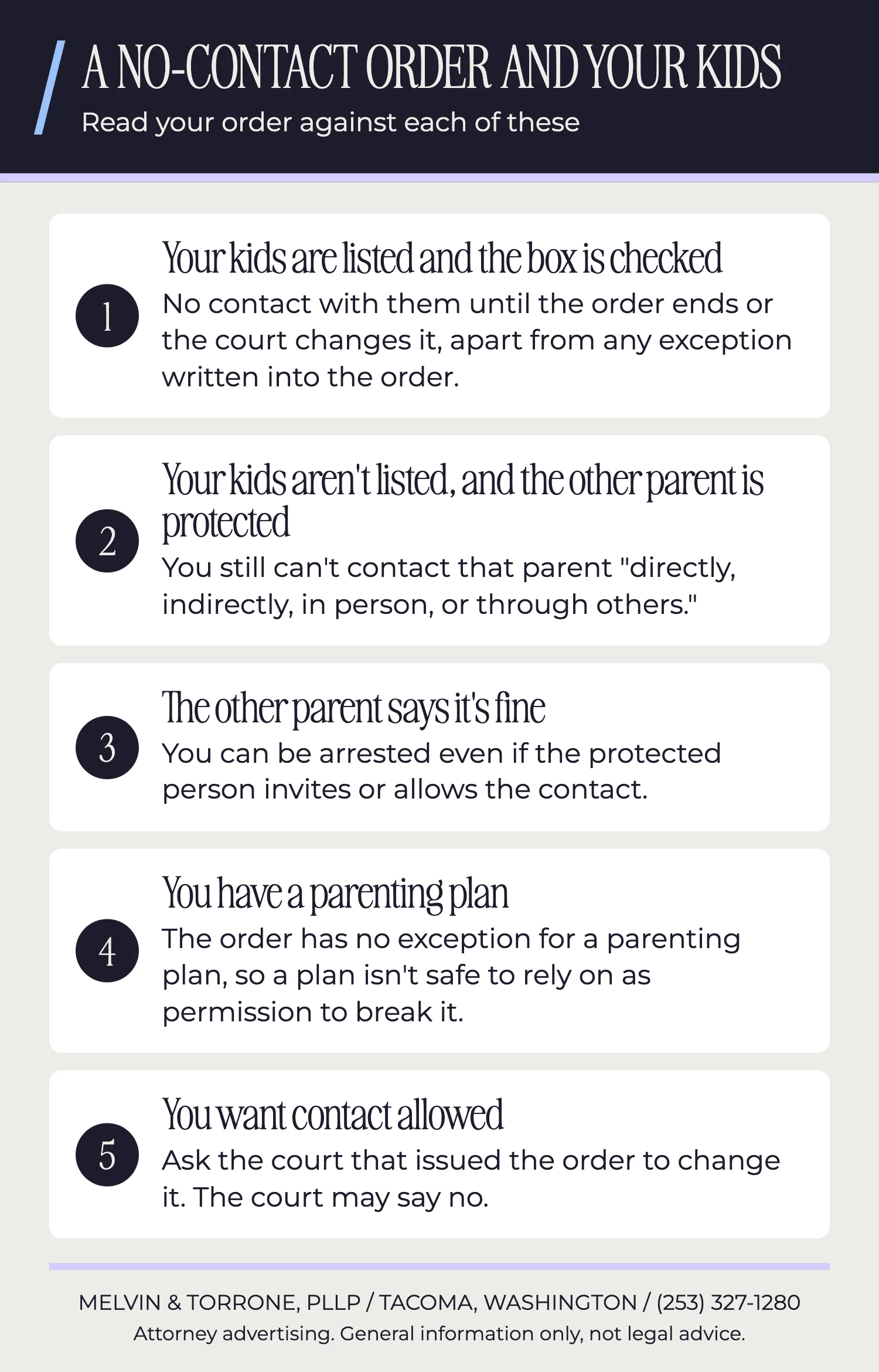
Now read your order against these situations:
- Your kids are listed and the no-contact box is checked. No contact with them until the order ends or the court changes it, apart from any exception written into the order.
- Your kids aren’t listed, and the other parent is protected. You still can’t contact that parent “directly, indirectly, in person, or through others.” If the stay-away box is checked, the protected person’s home can be off limits too, within 1,000 feet if no distance is entered, even when your kids live there. The form’s “through others” wording could cover a visit that depends on reaching the other parent. We didn’t find a court ruling on this.
- Your kids aren’t listed, and the protected person isn’t their other parent. The order may leave your parenting time alone, depending on who the kids live with. Have a lawyer read it.
- There’s an “other:” line. The form has no checkbox for parenting time or child exchanges, so any exception would be written there or in a changed order.
Which Order Controls When a No-Contact Order and a Parenting Plan Conflict
No statute, court rule, judges’ manual passage or appellate opinion we read says a no-contact order always beats a parenting plan, or the reverse. The judges’ manual says “which court order controls will depend on a number of variables including which case is being heard first, what laws are applied to each specific case, and the statutory purpose of the competing orders in light of the domestic violence statutes.” So there’s no one-line rule to give you.
The statewide form doesn’t settle it either. It warns, “This order does not modify or terminate any order entered in any other case. You are still required to comply with other orders.” It doesn’t say what happens when a parenting plan allows what the no-contact order forbids.
The order says only the court can change it and that you can be arrested even if invited, and it has no exception for a parenting plan. So a plan isn’t safe to rely on as permission to break it, and the way to get contact allowed is to ask the court that issued the order to change it. We didn’t find a court ruling that says this directly. RCW 10.99.040(1)(f) has the criminal court try not to lessen protections other courts ordered, which doesn’t settle this conflict.
- An invitation doesn’t change this. The form and RCW 10.99.040(4)(b) both say you can be arrested even if the protected person invites or allows the contact, and “You have the sole responsibility to avoid or refrain from violating the order’s provisions.”
- Courts have said the same about consent. In State v. Dejarlais, 136 Wn.2d 939 (1998), the Washington Supreme Court held consent isn’t a defense, in part because it “would result in a de facto modification.” That case involved a civil order under former chapter 26.50 RCW. State v. Jacobs, 101 Wn. App. 80 (2000), said the same about a domestic violence no-contact order, as a supporting statement in a Court of Appeals search-and-seizure case.
- Civil protection orders work differently. Under RCW 7.105.310(1)(f), one may suspend contact under an existing plan, “subject to further orders in a family law proceeding.” That’s the one statute we found that fits the two together, and it’s written for civil orders. The one-year cap on contact with your kids in RCW 7.105.315 is written for those civil orders, though the Torres case below told a sentencing court to take that legislative limit into account. More on domestic violence protection orders.
- You can ask a court to reconcile orders. RCW 2.56.240 calls for a process to do this, and guidelines in the manual say a court “shall consider reconciling conflicting or duplicative orders.” That’s a duty to consider, with no promised result, and we didn’t find a Pierce County procedure for it.
How to Ask the Criminal Court to Change the Order
You ask the court, never the other parent. The order’s “through others” line could cover asking the other parent to file for you.
If you’re the protected parent, the decision to file is yours, and your safety comes first. Pierce County Superior Court’s form has you state the request is “of my own free will” and warns “the court may be unable to reinstate the order under this criminal cause number.” Pierce County District Court’s form points protected people to the Crystal Judson Family Justice Center, (253) 798-4166, www.familyjusticecenter.us.
When and Where to Ask
- First appearance. After a domestic violence arrest, you appear before a judge within one judicial day under RCW 10.99.045, and the court decides on a no-contact order then. That’s the first chance to raise your kids.
- Later in the case. The form says “Only the court can change the order upon written request,” and the state’s brochure says “The crime victim or the defendant may file a motion to modify or terminate the order themselves.” The Pierce County forms we read are filed on the criminal case.
- Release conditions are separate. The release rules let a court amend conditions it set under those rules “at any time on change of circumstances, new information or showing of good cause” (CrR 3.2(k)(1), CrRLJ 3.2(j)(1)). A no-contact order under RCW 10.99.040 is its own order, so ask a lawyer which one you’re dealing with.
What You Can Ask For
The order doesn’t have to be all or nothing. You can ask for:
- Supervised visits with your kids.
- Written terms for exchanges or child-related messages, in the “other:” line or a replacement order.
- Removing the kids from the order while the other parent stays protected.
Pierce County District Court’s form says the judge considers the motion, the defendant’s criminal history, case documents and safety steps, and the motion may be denied without a hearing. Pierce County Superior Court’s form asks about the defendant’s domestic violence treatment and drug or alcohol use. Those forms are written for the protected person, and we didn’t find a matching list for a defendant’s motion. Safety is why the order exists, so any request has to address it.
What the Appellate Cases Say
These are sentencing cases, decided after a conviction, and we don’t stretch them to pretrial orders.
- State v. Ancira, 107 Wn. App. 650 (Court of Appeals 2001). An order barring all contact with non-victim children violated the right to parent because it wasn’t reasonably necessary, and the court said supervised visitation “might be appropriate.”
- State v. Torres, 198 Wn. App. 685 (Court of Appeals 2017). On remand, the trial court was told it “shall consider less restrictive alternatives, such as supervised visitation.”
- In re Rainey, 168 Wn.2d 367 (Washington Supreme Court 2010). No contact with a daughter who was the victim was upheld as to who it covered, but a lifetime term with no stated reason was not.
You can’t count on a court lifting the order because of any of these cases. We didn’t find a published opinion on a pretrial order naming a defendant’s own kids. That doesn’t prove none exists.
What the Family Court Does While the Charge Is Pending
Neither case waits for the other. The criminal court can’t delay a case because of a divorce or other civil case, under RCW 10.99.040(1)(a), and the family court doesn’t need a conviction to decide what happened. So a DV charge can affect your custody case before anyone decides the charge.
- How the judge finds out. Before entering a permanent plan, the court must check the judicial information system under RCW 26.09.182.
- Temporary plans. A parent starts one by motion under RCW 26.09.194, and the sworn statement has to list any RCW 26.09.191 circumstances likely to pose a serious risk to the child. A pending charge can come in there.
- What the court weighs. Under RCW 26.09.197, the court gives particular consideration to the child’s bond with each parent and to what causes the least disruption.
- No conviction required. The judges’ manual says “a criminal history is not required to establish a history of domestic violence,” and the family court decides the conduct itself under the rules of evidence, unless the parties chose an informal family law trial. A pending charge isn’t that finding. That passage doesn’t tie the finding to a conviction, so a dismissal may not end the family court’s review of the same events.
If the court finds a history of domestic violence, limits on residential time are required under RCW 26.09.191(4)(a)(iii). See how a criminal conviction affects your custody case for what they look like. If a family court order allows you time, the no-contact order’s terms stay in place until a court changes them, so have a lawyer raise the conflict before you act on it. If your plan requires you to do something the order forbids, have a lawyer raise it with both courts.
Pierce County and Tacoma Court Details
Several courts can issue these orders, so check the name at the top of yours. These details come from the city’s court page, the county’s posted instructions and its February 2026 announcement.
| Court | What we found |
|---|---|
| Tacoma Municipal Court | County-City Building, 930 Tacoma Ave South. Hears misdemeanor and gross misdemeanor cases under city ordinances, including domestic violence offenses. (253) 591-5357. |
| Pierce County Superior Court, criminal | The protected person files with the Clerk’s Office and schedules with Criminal Administration, with at least five business days’ notice to the prosecutor. |
| Pierce County Superior Court, family | In February 2026, the county announced all family law departments and Family Court Services staff would be on the County-City Building’s 7th floor. |
The Pierce County instructions we read are written for the protected person. We searched the Superior Court’s local rules, as amended September 1, 2026, and didn’t find a criminal rule on a defendant’s motion. So ask the court or a lawyer how a defendant makes that motion.
When to Talk to a Lawyer Who Handles Both Kinds of Case
It makes sense to talk to someone who handles both when:
- A divorce, custody or parenting plan case is open or about to be filed.
- Your kids are listed on the order, or your plan and the order conflict.
- You’re being asked to sign a declaration in the family case while the charge is open.
If you have a family case, you may know this already. The divorce or custody case is running, then there’s an arrest, and now a no-contact order says you can’t go home and can’t call your own kids. That’s a lot to carry at once. What gets said in the family case can show up in the criminal one, and the family court pays close attention to how the criminal case is going. We handle both kinds of case in this office, so one team looks at what gets filed, what gets said and when.
You can schedule a free, confidential consultation with our domestic violence lawyers. We’ll read your order alongside any parenting plan and go through what you can ask for.
FAQ
1. Can I text the other parent if it’s only about the kids?
Not if they’re protected by the order. The statewide form’s only stated exceptions are mailing or serving court documents through a third party and contact by your lawyers, unless a court has written something else into your order.
2. Can a relative pick up my kids and bring them to me?
If the kids are listed and your order has no written exchange terms, no. If they aren’t, a relative arranging it with the other parent can fall under the form’s “through others” wording. You can ask the court for written exchange terms.
3. What if the other parent doesn’t want the order?
The prosecutor may ask for one “regardless of the victim’s wishes,” says the state’s brochure, and the order stays in place unless it expires, ends with the case, or a judge changes it. The protected person can file their own motion, and the judge decides.
4. Does the order end if the charge is dismissed?
A pretrial order ends on acquittal or dismissal, and an order issued before charges expires at arraignment or within 72 hours if none are filed, unless the court extends it. An order tied to a misdemeanor or gross misdemeanor sentence can last up to five years under RCW 10.99.050. Other orders can stay in effect.
This article is attorney advertising and shares general information only, not legal advice. Reading it or contacting Melvin & Torrone, PLLP does not create an attorney-client relationship. Every situation is different, so talk with a licensed attorney about yours.

Chris Torrone
Founding Partner, Melvin & Torrone PLLP
Chris Torrone is a dedicated advocate for clients facing family crises and criminal charges. With 20 years of experience practicing in Pierce County courts, Chris has built a reputation for meticulous case preparation and creative problem-solving in high-stakes litigation.