
Second DUI in Washington: Lookback Periods, Jail Time, and What Changes From a First Offense
If you’ve been arrested for DUI again, the first thing you need to know is whether the old case makes this a second offense. In Washington, a court sentences a new DUI as a second offense under RCW 46.61.5055 when the arrest for one prior offense falls within seven years before or after the new arrest. If you’re convicted and the test was under 0.15, the minimum rises from 24 hours in jail to 30 days in jail plus 60 days of electronic home monitoring.
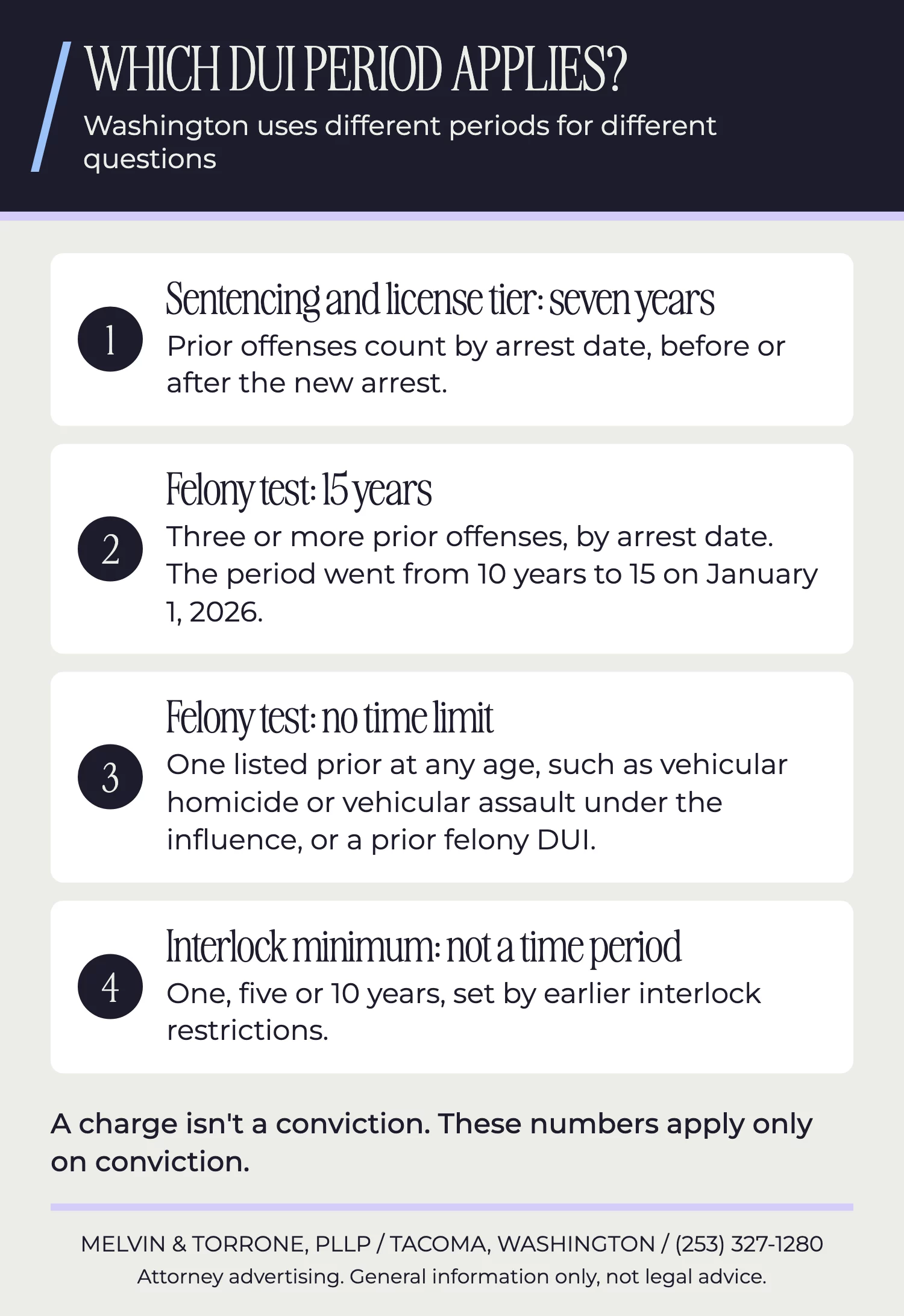
Washington doesn’t use one timetable for everything. Seven years covers sentencing and your license. Fifteen years has covered the felony test since January 1, 2026. Both count from arrest dates. The interlock minimum depends on whether the Department of Licensing (DOL) restricted you before, and “prior offense” includes more than DUI convictions. A charge isn’t a conviction, and the penalty numbers below apply only on conviction.
Below are the first dates, how each period is counted, what counts as a prior, what changes for jail, license and interlock, and the options that remain.
Torrone’s Takeaways
- You’ve got seven days to request a DOL hearing, and the fee is $375.
- Sentencing’s seven-year period counts arrest dates, before or after the new arrest.
- A DUI is a felony with three or more prior offenses in 15 years, up from 10 on January 1, 2026, or with certain listed priors at any age.
- A deferred prosecution counts as a prior offense, and so does a reckless or first-degree negligent driving conviction first charged as DUI.
- If you’re convicted with one prior in seven years, the minimum is 30 days of jail and 60 of home monitoring, or 45 and 90 at 0.15 or on a refusal.
- Your interlock minimum is one, five or 10 years, depending on earlier interlock restrictions.
Table of Contents
- Torrone’s Takeaways
- If You Were Just Arrested: Dates and First Steps
- Washington’s DUI Lookback Periods: Seven Years, 15 Years, and No Time Limit
- What Counts as a Prior Offense in Washington
- Second DUI Jail Time and Fines Compared With a First Offense
- Your License After a Second DUI: Two Separate Tracks
- Ignition Interlock After a Second DUI: One, Five, or 10 Years
- Deferred Prosecution, Reductions, and Your Record
- Talking With Us About a Second DUI
- FAQ
If You Were Just Arrested: Dates and First Steps
You probably have paperwork from the arrest in front of you. You have two dates coming, the deadline for a license hearing and your first court date. Here’s what the law sets for the first days.
- Hearing request. You’ve got seven days to request a DOL hearing, in writing, on the form the officer hands you, with a $375 fee. RCW 46.20.308 counts from when the notice is given, and DOL’s page says within 7 days of your arrest. The fee may be waived for indigent applicants.
- Temporary license. Your notice works as a temporary license for 30 days from the arrest. If you didn’t request a hearing or you lost it, the suspension starts then.
- First court date. If you were served with a citation at arrest, RCW 46.61.50571 requires you to appear in person within one judicial day, unless a local rule sets the earliest practicable day. This appearance cannot be waived. If you weren’t served at arrest, different timing applies. Pretrial conditions get decided at this appearance, and they can include electronic or alcohol abstinence monitoring.
- Which court. Tacoma Municipal Court hears DUI cases under City of Tacoma ordinances. For an arrest elsewhere in Pierce County, see our Washington DUI guide.
- Driving. You can apply for an ignition interlock driver license at any time, including right after the arrest. The FAQ has the requirements.
- Your old case. Find its arrest date and how it ended (conviction, deferred prosecution or reduction). You’ll need both facts for the next two sections.
Washington’s DUI Lookback Periods: Seven Years, 15 Years, and No Time Limit
One old arrest can fall outside one period and inside another, because each period is used for a different legal decision.
| Period | What it decides | What gets counted |
|---|---|---|
| Seven years | Jail, home monitoring and fine tier; license length after a conviction | Prior offenses, by arrest date, before or after the new arrest. RCW 46.61.5055(14)(c) |
| Seven years, DOL | License action after the arrest | A previous incident within seven years that led to DOL action. RCW 46.20.3101 |
| 15 years | Felony test: three or more prior offenses | The same list of prior offenses, by arrest date. RCW 46.61.5055(14)(d), RCW 46.61.502(6)(a) |
| No time limit | Felony test: one listed prior | A prior conviction for vehicular homicide or vehicular assault under the influence, a comparable out-of-state offense, or a prior felony DUI or felony physical control. RCW 46.61.502(6)(b) |
| Not a time period | Interlock minimum | Earlier interlock restrictions (see the interlock section) |
Courts count from arrest dates, not conviction dates. For example, an earlier arrest six years and eleven months before the new one is within seven years, so the new case is sentenced as a second offense. An earlier arrest eight years before means first-offense sentencing for jail and fines, and that arrest still falls inside the 15-year period.
“Before or after” matters too. RCW 46.61.5055(14)(c) says “within seven years” means the arrest for a prior offense “occurred within seven years before or after the arrest for the current offense,” so the window isn’t limited to older arrests. If you’ve got two open cases, ask a lawyer how they interact.
On January 1, 2026, ESHB 1493 (Laws of 2024, ch. 306) moved the felony window from 10 years to 15. Sentencing stayed at seven years, and older articles may still say 10 for the felony test. Under RCW 46.61.502(6), a felony still takes three or more prior offenses in that window or a no-time-limit prior, so one old gross misdemeanor DUI does not do it alone.
What Counts as a Prior Offense in Washington
You may have finished a deferred prosecution and put the old case behind you, and the statute still lists it as a prior offense. The list in RCW 46.61.5055(14)(a) is wider than DUI convictions:
- A DUI or physical control conviction, including under a local ordinance.
- A deferred prosecution granted on a DUI or physical control charge.
- A conviction for first-degree negligent driving, reckless driving or reckless endangerment, if the charge was originally filed as DUI or physical control.
- Boating under the influence, and listed offenses involving aircraft, off-road vehicles, snowmobiles and commercial vehicles.
- Vehicular homicide or vehicular assault committed under the influence.
- An out-of-state conviction that would have been a violation here, and an equivalent out-of-state deferred prosecution.
A reckless driving conviction that was never charged as DUI isn’t on the list. So what matters is how the old case was charged and how it ended.
Second DUI Jail Time and Fines Compared With a First Offense
On a first offense, a judge can choose home monitoring or a sobriety program instead of jail. On a second, that choice takes a written finding.
| Case | Minimum if convicted | Alternative to the minimum |
|---|---|---|
| First, under 0.15 | 24 consecutive hours; fine of $350 to $5,000 | Court’s discretion: at least 15 days of home monitoring or 90 days of 24/7 sobriety monitoring |
| First, 0.15 or refusal | 48 consecutive hours; fine of $500 to $5,000 | Court’s discretion: at least 30 days of home monitoring or 120 days of 24/7 |
| Second, under 0.15 | 30 days of jail and 60 days of home monitoring; fine of $500 to $5,000 | Only with a substantial-risk finding: at least 180 days of home monitoring or 120 days of 24/7 |
| Second, 0.15 or refusal | 45 days of jail and 90 days of home monitoring; fine of $750 to $5,000 | Only with a substantial-risk finding: at least six months of home monitoring or 120 days of 24/7 |
Every row runs to a 364-day maximum under RCW 46.61.5055. On a second offense, the alternative needs a finding that the minimum “would impose a substantial risk to the offender’s physical or mental well-being,” and the court must write down its reasons. You’d pay for home monitoring, at the rate the county or city sets. If you’re convicted with one prior in seven years, the minimum includes jail, and if you refused the test, you’re sentenced in the 0.15 tier.
Three more parts of a second-offense sentence:
- Child under 16 in the vehicle. With one prior in seven years, the court adds five consecutive days and a $2,000 to $5,000 fine for each such passenger. If a parenting plan is also in play, see how a conviction affects custody.
- Probation. Up to five years, on mandatory conditions: a valid license, insurance, no driving at 0.08 or above, no test refusal, and no driving without a required interlock. Each violation means 30 days of jail that cannot be suspended or deferred, plus a 30-day license suspension.
- Assessment. Expect an expanded substance use disorder assessment, and treatment if it’s deemed appropriate.
Your License After a Second DUI: Two Separate Tracks
If your first thought was “I need to keep my license,” you need to know there are two processes. The DOL hearing affects only the suspension that follows the arrest, and a conviction brings its own license action under its own test. These numbers are for drivers 21 and over.
| Track | When it starts | Length with an earlier case |
|---|---|---|
| DOL action after arrest | 30 days after arrest | Test at 0.08 or above with a previous incident in seven years that led to DOL action: two years. Refusal with an earlier incident: two years. For comparison, a first incident: 90 days, or one year for a first refusal. |
| Conviction | 45 days after DOL receives notice | Under 0.15: two years, or until you’re evaluated and complete or enroll in six months of 24/7 monitoring, never less than one year. 0.15 or above: 900 days. Refusal: three years. |
RCW 46.20.3101 sets the first row, and RCW 46.61.5055(9) the second. Two more details:
- Time you’ve already served on the same arrest counts day for day against the conviction period.
- After a revocation, RCW 46.20.355 puts your driving privilege on probationary status for five years. This status isn’t part of the record available to insurers.
Ignition Interlock After a Second DUI: One, Five, or 10 Years
What sets your interlock minimum is whether DOL restricted you before, not the number of priors in seven years. RCW 46.20.720(3)(c) sets three tiers:
| Your interlock history | Minimum restriction |
|---|---|
| Not previously restricted | One year |
| Previously restricted once | Five years |
| Previously restricted twice | 10 years |
If a deferred prosecution or conviction in your first case put an interlock restriction on your record, the minimum on this one is five years. If no such restriction was ever placed, the minimum is one year. When a restriction follows a conviction, one from a deferred prosecution on the same incident is not considered a prior restriction. Interlock applies after any DUI conviction, including a first, under RCW 46.61.5055(5)(a). The 10 years in this table is a length of restriction, not a lookback.
Your restriction can last longer than the number in the table, for these reasons:
- To take the device off, DOL needs a vendor’s declaration of 180 straight days with none of the violations the statute lists, such as a start attempt at 0.04 or above, a failed retest, a missed appointment or an unauthorized removal, plus a certified technician’s finding of no tampering.
- The period pauses for any time you have no device installed on a vehicle you own or operate.
- A child under 16 in the vehicle adds 12 months per passenger, or 18 at 0.15 or on a refusal.
- Driving without a required interlock is its own gross misdemeanor under RCW 46.20.740, and a conviction adds 180 days.
You pay for installation, removal and leasing, plus $21 a month paid through the interlock company, which may be waived for indigent people.
Deferred Prosecution, Reductions, and Your Record
Eligibility for a deferred prosecution on a second case turns on whether your first case used one and whether you have a prior conviction that counts as a prior offense.
Deferred Prosecution
- If you used one on your first violation. RCW 10.05.010 lets you petition for a second on your next violation if you have no other prior conviction that counts as a prior offense. Your first deferred prosecution isn’t counted for that purpose.
- If you didn’t use one on your first violation. Under RCW 10.05.010(7), you remain eligible to petition, once, if the court makes the findings the statute requires.
- If you’re still under the first one. It must be revoked before the second is entered.
- What it requires. A petition with a written assessment, filed at least seven days before trial unless good cause is shown. RCW 10.05.020 also requires you to stipulate to the facts in the police report and waive trial rights, and the court will not accept a petition from someone who sincerely believes they are innocent.
- What follows. RCW 10.05.140 requires an interlock on a substance-use-based case and no driving without a valid license and insurance. Finishing the program can lead to dismissal, and the deferred prosecution still counts as a prior offense in any later case.
Reductions
A conviction for first-degree negligent driving, reckless driving or reckless endangerment that started as a DUI charge counts as a prior offense for a later DUI. Under RCW 46.61.5249(4), a person convicted of first-degree negligent driving with a prior offense in seven years must also install an interlock on all vehicles they operate.
Your Record
If you’re thinking “I need this off my record,” the ordinary vacation statute, RCW 9.96.060, bars vacating a DUI or physical control conviction. Our guide to vacating a record in Washington covers the wider rules. If a teaching license is on your mind, see whether you can teach with a DUI.
Talking With Us About a Second DUI
Most DUI calls come to us the morning after, from someone who hasn’t slept and who’s more worried about their license and their job than about court. We start by separating the two cases, the criminal charge and the DOL license process. Then we get the paperwork: the citation, the police report, the breath or blood results and the maintenance records for the machine. We go through how the stop happened and what was tested, and we tell you what we see.
If a parenting plan is part of this too, our firm practices both criminal defense and family law. When you’re ready to talk it through, you can schedule a free, confidential consultation with our DUI defense lawyers.
FAQ
1. Is a second DUI a felony in Washington?
Not by itself. A second DUI is a gross misdemeanor with a maximum of 364 days, unless you have three or more prior offenses in 15 years or a listed prior at any age. In those cases DUI is a class B felony, and physical control is class C.
2. Does a DUI from 10 years ago still count?
Not for second-offense jail, fine and license tiers, which look back seven years. It does stay in the 15-year felony count, and that count matters only if you have three or more prior offenses in the period.
3. Does a DUI from another state count in Washington?
Yes, if it would have been a violation here. Equivalence gets argued case by case. In State v. Gregory (2022), a Washington appeals court treated an Idaho withheld judgment as equivalent to a Washington deferred prosecution, so it counted as a prior offense.
4. Can I still drive to work after a second DUI?
Possibly, with an ignition interlock driver license. It takes an interlock on every vehicle you operate and proof of financial responsibility, such as an SR-22. Employer vehicles driven for work can be exempt with an employer declaration.
5. Can a second DUI be expunged in Washington?
Washington’s word is vacated, and the ordinary vacation statute, RCW 9.96.060, doesn’t allow it for a DUI or physical control conviction. A reduced charge may qualify, only if at least 10 years have passed since that arrest with no later alcohol or drug violation in that time, and other conditions are met.
This article is attorney advertising and shares general information only, not legal advice. Reading it or contacting Melvin & Torrone, PLLP does not create an attorney-client relationship. Every situation is different, so talk with a licensed attorney about yours.

Chris Torrone
Founding Partner, Melvin & Torrone PLLP
Chris Torrone is a dedicated advocate for clients facing family crises and criminal charges. With 20 years of experience practicing in Pierce County courts, Chris has built a reputation for meticulous case preparation and creative problem-solving in high-stakes litigation.